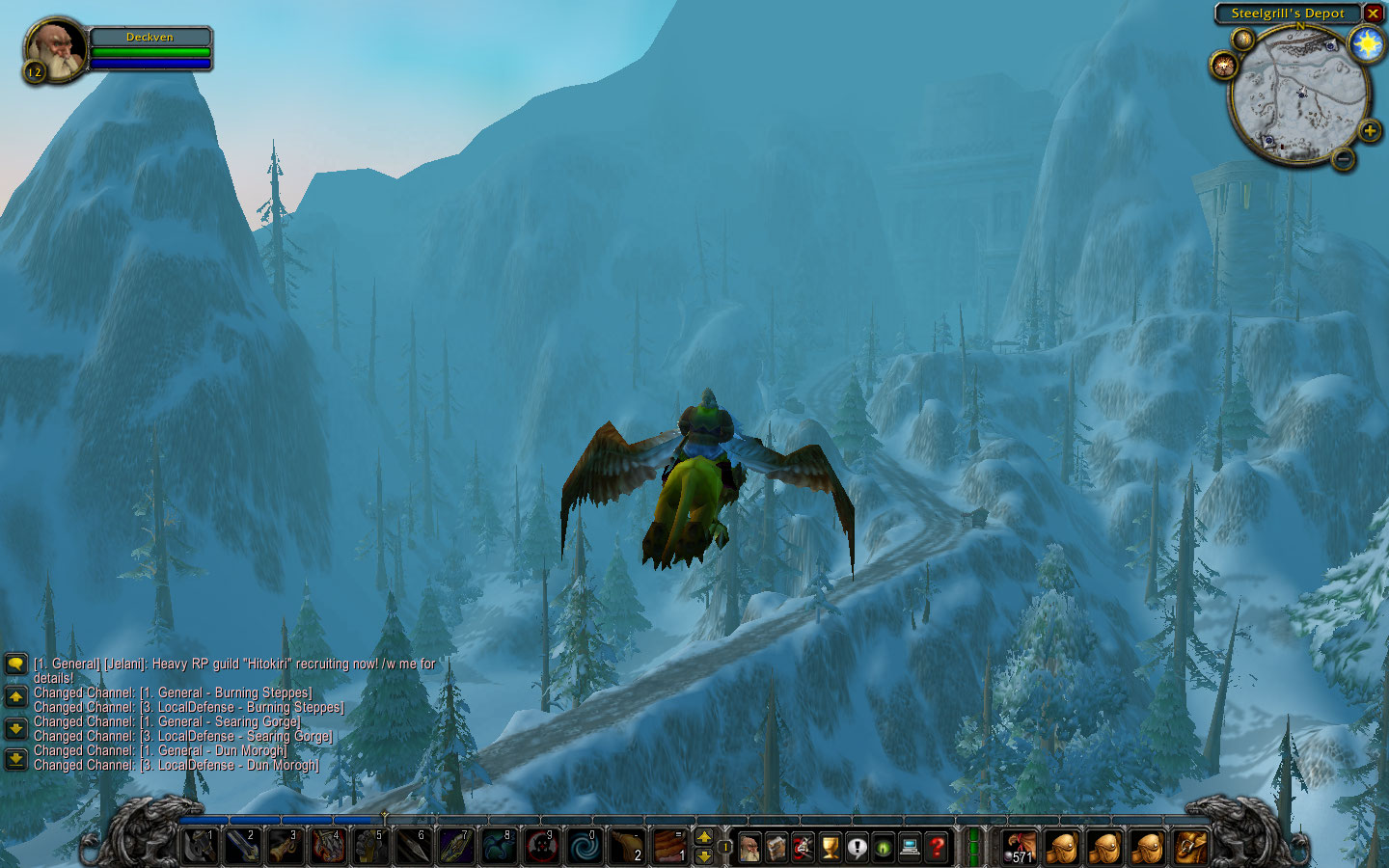
When people complain these days that there are few players in open-world locations, I always feel like saying that it wasn’t much different back then. In the Coldridge Valley, and even in Dun Morogh itself, I only encountered a couple of other players. It was only around and within Ironforge that I saw any crowds.
Previous: WoW Payer Diary Part 2
From Ironforge to Darkshore
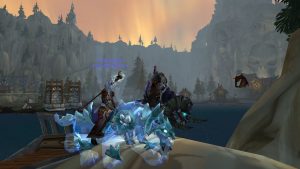
My first glimpse of the dwarven capital was as that same level-5 Drovosek. After what had seemed like complete silence in the zone chats, I finally experienced what “social life” in WoW was like. A couple of dozen players were bustling about in Ironforge’s central square, many of them mounted, among which the elven night sabers particularly stood out. The chat window came alive, filled with cryptic phrases like “LF tank for Kara, last spot” and discussions completely unrelated to the game. Advertisements from gold sellers also flashed by—back then, a thousand gold cost around ten to twelve euros. While my English was good, the slang they used sometimes left me utterly baffled.
As I mentioned earlier, Moonglade-EU was a role-playing server (PvE-RP). If we were to draw parallels with real life, it was like a provincial town populated by good-natured Europeans. The atmosphere on the server was generally reminiscent of EverQuest’s Barren Sky. For the first few months, I didn’t encounter any of the sillier things, like the “anal” theme in the general chat, aggressive behavior, or similar nonsense that I will often see on more populated servers like Azuregos. This was partly due to the fact that I didn’t start group play until the summer, and before that, I was mostly busy with solo questing. And even when I did start doing dungeons, unsuccessful pulls or wipes on trash didn’t result in responses like, “crab, did you buy an account?”
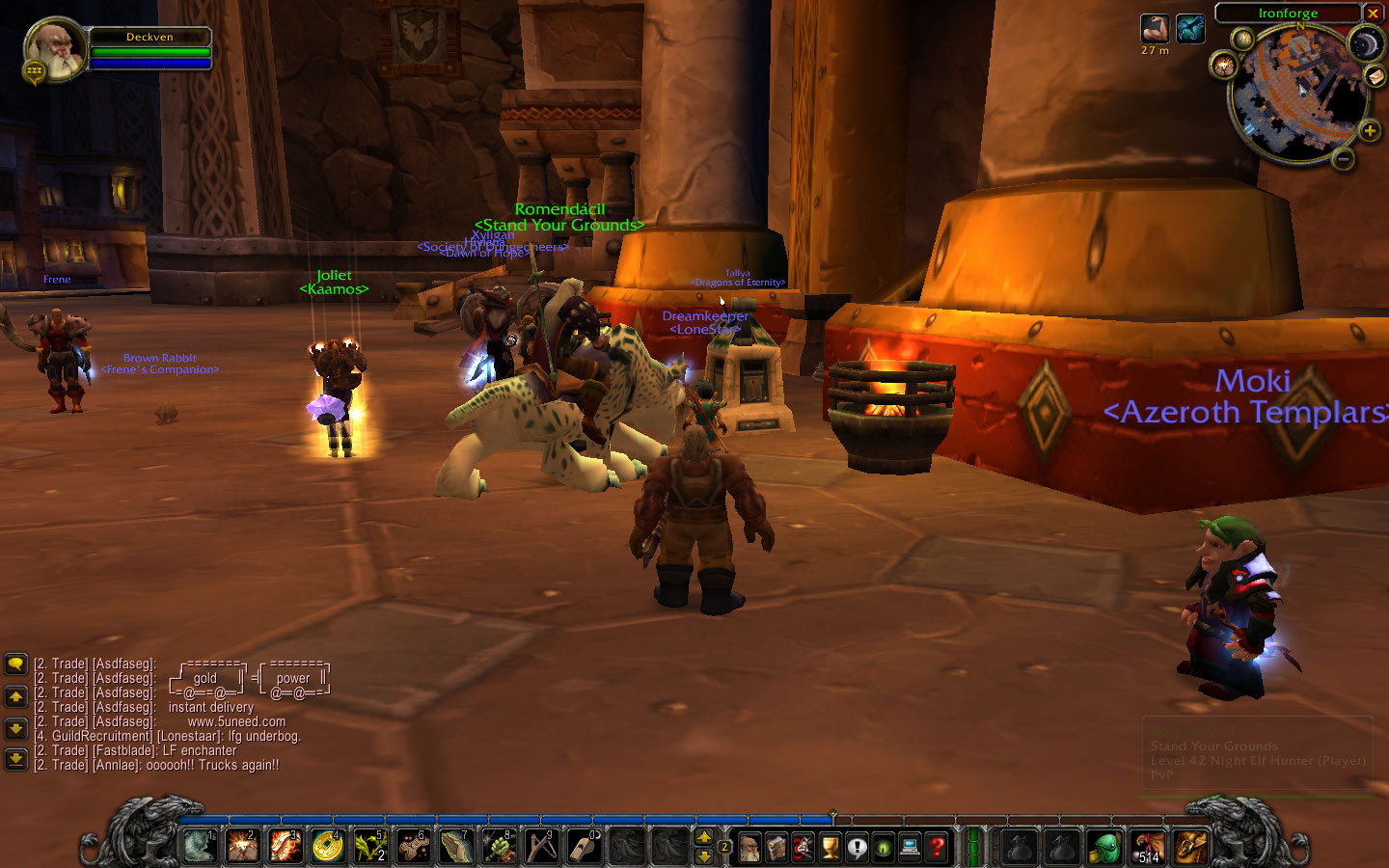
The server’s population consisted primarily of British and Scandinavian players, though there were also plenty of Russian-speaking players from the CIS countries. There was even a whole guild made up of these “compatriots.” I met some of these guys through the chats, but I wasn’t in any hurry to join the guild, and to be honest, I didn’t really want to go “to my own.” It wasn’t that I felt any hostility—I was just more interested in meeting players from other countries. As for role-playing, things were quite active, with several guilds on the server taking it very seriously. Although, not everyone actually played their roles, as I realized when, to my “Hail to you, draenei!” someone replied with something like, “okay, it’s not a big deal to put on a show here, I’m just leveling up.”
The first place I explored in Ironforge was the auction house. After poking around the unfamiliar interface for a bit, I managed to list some items for sale, and then I set off in search of a skill trainer. Back in those days, abilities had ranks, and every time you leveled up, you had to trek to a trainer to purchase the new ones. Here, too, WoW triumphed over EQ2 in its approach. In EQ2, ability levels were increased using books, which were quite expensive. But in Azeroth, learning was much more affordable. Selling ore and skins was enough for me to always stay ahead of the curve. Simply put, life was definitely improving.
Ironforge wasn’t the only Alliance city I visited back then, of course. I also made a detour to Stormwind. But compared to the two, I much preferred the dwarven capital. Stormwind just felt like a pretty standard medieval city. Besides, Stormwind was much smaller then than it is now—the harbor didn’t appear until patch 3.0.2, the Wrath of the Lich King pre-patch, and it accounts for about a third of the city. Ironforge, a city carved directly out of the rock, was far more majestic, reminiscent of Moria, and most importantly, it had incredible music.
After trekking through the snowy landscapes of Dun Morogh, I decided to venture further. However, I had no idea where to go. The Battle Chest included helpful guides, including location maps, but strangely, there were no general maps of Azeroth. I only learned about the existence of Thottbot and Wowhead in May. In short, I had to rely on Google and scour the forums for guidance.
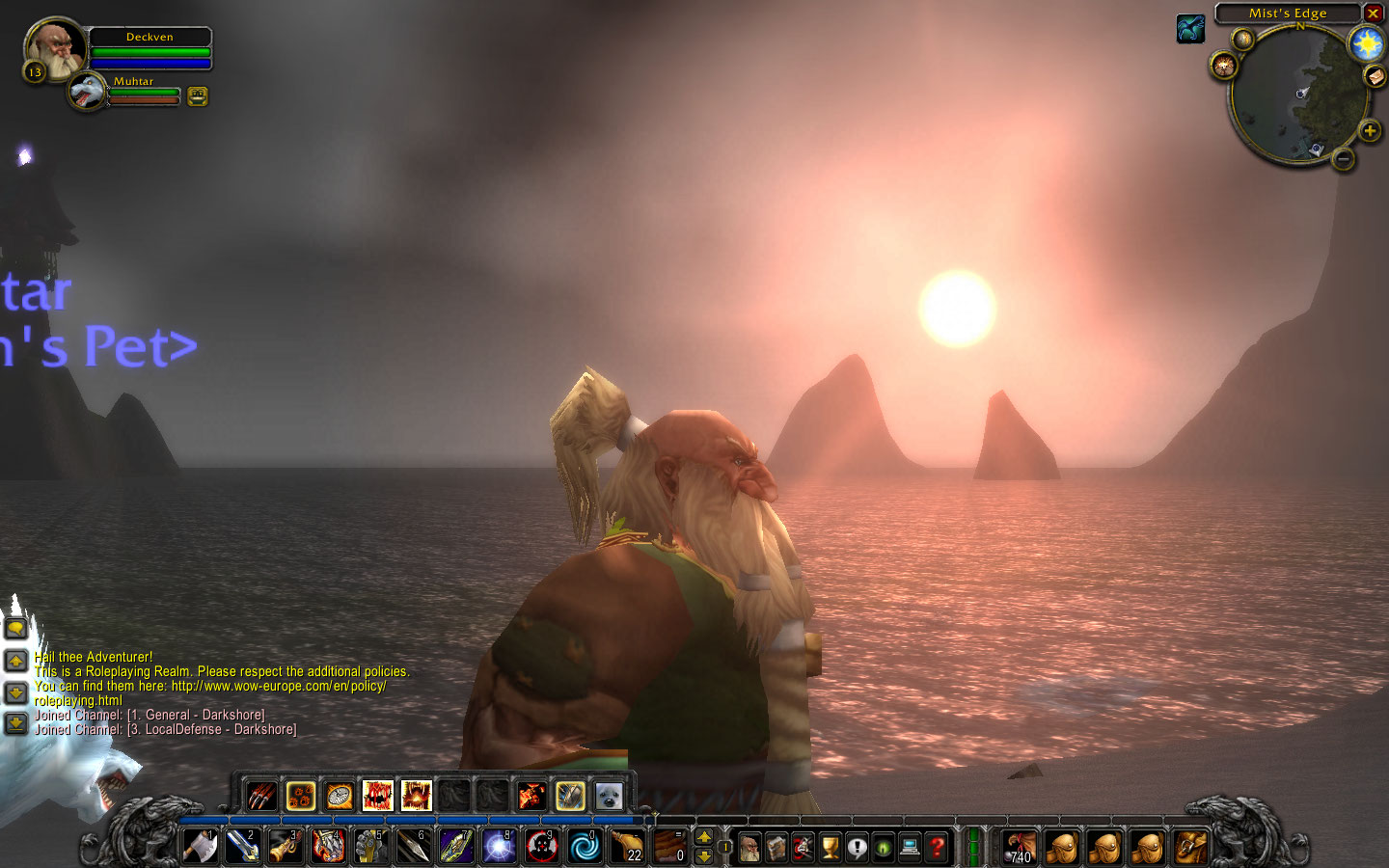
To be honest, the leveling process in WoW was, at times, tedious, unless it involved captivating quest chains. This later became the reason why I didn’t engage in alt leveling until mid-Wrath of the Lich King—and even then, my first alt was a draenei Death Knight, who started at level 58. Levels just came slowly. Having started with Deckven on March 23rd, I only reached level 10 by the start of April. And by the end of April, I had barely reached level 22. Roughly speaking, it took two or three evenings of playing to gain a single level. What truly pleased me, however, were the new locations and the process of gearing up my character. Again, keep in mind that this was during a time when there were no heirloom items. Quest rewards felt valuable, and trips to the auction house weren’t just for selling goods, but also to seek out new treasures. I still remember my first “blue” Guttbuster gun, bought for over twenty gold, which was a considerable sum for me. And you know what? I used that gun all the way until about level 30.
My next stops were Khaz Modan and the Redridge Mountains, but I didn’t linger there for long. I’d been drawn to the night elves ever since Warcraft III, and I decided to continue my adventures in Kalimdor. From the maps I’d managed to dig up online, it became clear that the journey across the ocean began in Menethil Harbor, in the Wetlands. Instead of using the tunnels that led from the lake into the Wetlands, I jumped straight down from the Khaz Modan Dam. Naturally, that ended with a run from the graveyard, though thankfully already within the Wetlands.
The adventures didn’t end there, though. The Wetlands were designed for characters around level 19-22, and at that point, I had barely scraped my way up to level 15. On the way, I ran into several packs of crocodiles and died another three times. But my determination was firm, and I eventually made it to the port. Menethil Harbor, like Auberdine in Darkshore, was quite battered by the Cataclysm. While the harbor itself, though half-flooded, was still functional, Auberdine had been utterly destroyed. The pier that we used to use to get from the ship to the elven settlement had been burned and ruined by Deathwing. Many of the quests in Darkshore started right there.
From the first moments, the location itself was enchanting. Gloomy forests hugged the shoreline, where it felt like dawn never broke. Ruins of ancient elven settlements were scattered about, along with the skull of an ancient monster, defeated long ago by the Guardians. It felt like a place where shadows of bygone times still lingered and would never fully pass.
I immediately fell in love with Darkshore, as well as Kalimdor in general, which I enjoyed far more than the Eastern Kingdoms. I spent most of my time here before reaching the first level cap. For a while, my hearthstone was even set in Darnassus, where I frequently went to the auction house. But that didn’t last long, as Ironforge, carved out of stone, was just much more appealing than the elven capital nestled in the crown of a tree growing at the edge of the world. However, I didn’t completely abandon the Eastern Kingdoms either and spent many days in Southshore, Arathi, and Alterac, digging for mithril.
Looking for a Guild
After exploring Darkshore, I found myself in Ashenvale. It was April, and two things became crystal clear to me. First, I wasn’t going back to EverQuest 2. WoW had surpassed its competitor in every way—more intuitive game mechanics, less demanding system requirements, and a world I was already familiar with from three games and two expansions. Second, and stemming from the first point, playing MMOs solo was just boring and tough. After all, having company is always useful in a new game, not just for material help, but also for guidance and camaraderie. Scouring websites for answers when you need help right then and there wasn’t ideal.
Learning from my experiences with my last MMO, I headed to the battle.net forums and posted an ad that a hunter was looking for a guild. Several players responded, including a group from the heavy RP guild, Vindication. Ultimately, I chose to join them, but before I delve into my character’s story…
For those unfamiliar with roleplaying, a “quent” is essentially a biography—a detailed story about the character you are playing. It covers their birth, upbringing, education, departure from home, past troubles, and so on. Your in-game actions during roleplay are guided by this backstory.
The story of my main, Deckven, was conceived long before I created him in World of Warcraft. According to the legend, Deckven belonged to the Squad of Craftsmen from the Dark Iron Clan. These were the clan’s most skilled artisans, involved in resource exploration, treasure hunting, and, of course, serving as something akin to an elite unit, entrusted with operations even in enemy territories. After the Dark Iron Clan’s defeat in the War of the Three Hammers, the Squad attempted to travel to the past and dissuade Thane Thaurissan from starting the war. They were thwarted by a dragon from the Bronze Flight, and Deckven found himself catapulted into the future—the present time of World of Warcraft. Later, I even wrote a short story, “Halls of Ulduar,” where the dwarf was called Dagenadin the Gatekeeper.
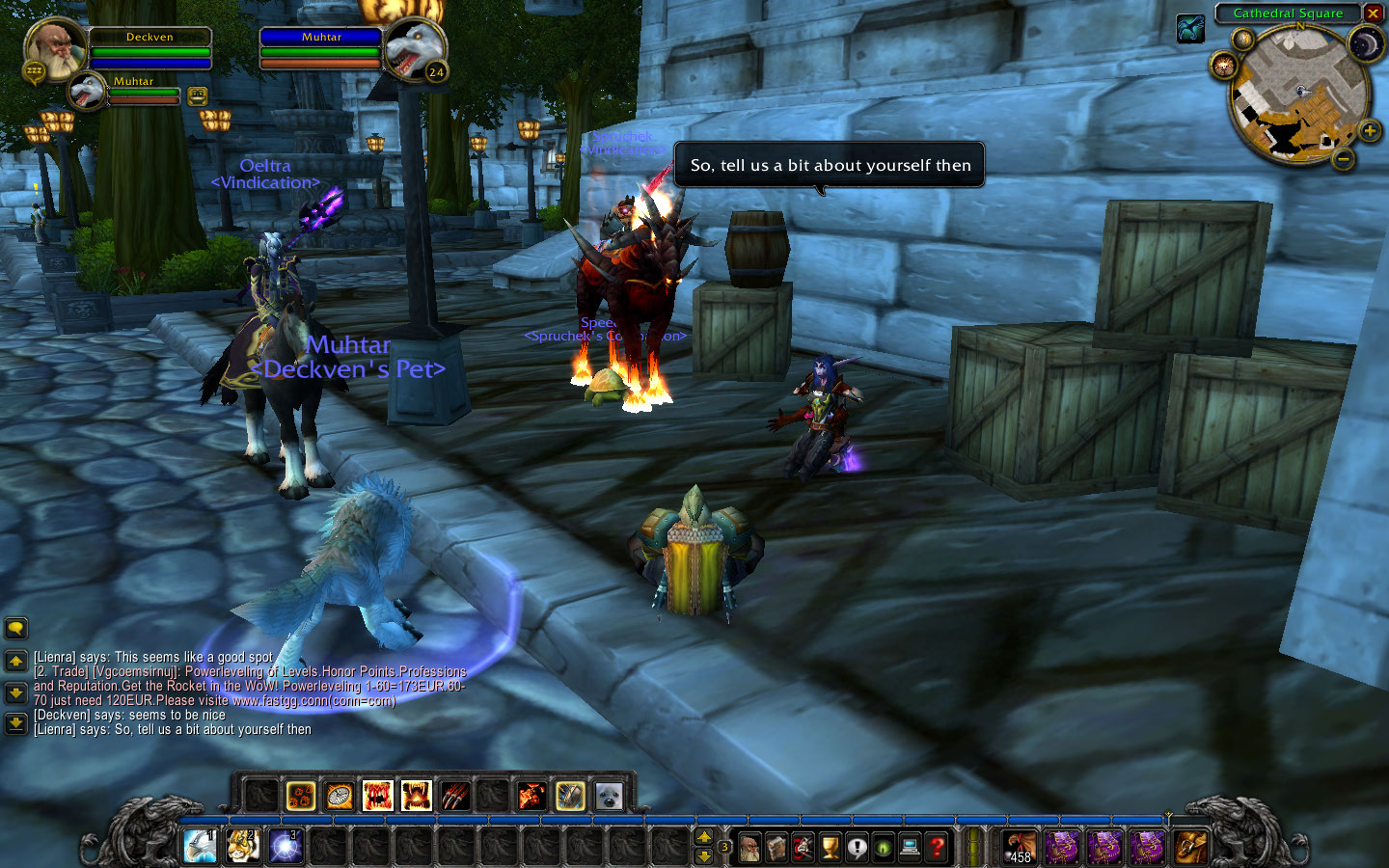
This was the story I shared with three officers from Vindication one pleasant May evening in the park of Stormwind. We sat on the pavement for almost an hour, speaking entirely in-character (IC). That interview was probably the most engaging guild application process I’ve experienced in my gaming career. After it was all over, Lienra, the officer who had replied to my forum post, sent me a private message confirming that I had been accepted.
As I already mentioned, Vindication was a “heavy RP” guild. The “hardcore” aspect was that roles were played not just during events. The guild had two chat channels, one for in-character conversations and one for out-of-character chat. It was unusual, amusing, and immersive—at least for the first month. After that, the double chat created some dissonance and occasionally became a strain, especially when it was necessary to contribute to the conversation.
In general, the “Vindicators” were a fascinating bunch, mostly from Scandinavia and Great Britain. Behind the night elf mask of Lienra, there was a mechanic from England. Our guildmaster, known as Oedlivani, was a Swedish documentary filmmaker. Oeltra, one of the most hardcore members of the guild who was always pushing for runs of the old vanilla raids like Naxxramas and Ahn’Qiraj, lived in London and was attending university.
The guild regularly organized roleplaying events like gatherings in Thousand Needles and Nagrand, initiations into the next rank in a cave near Uldaman, and, of course, attempted to raid. It was during these raiding attempts that a major conflict arose in the fall, but more on that later.
Next: WoW Player Diary Part 4